闯关东
Warner Bros Condemns Death Threats Made Against JK Rowling_我的网站

A |
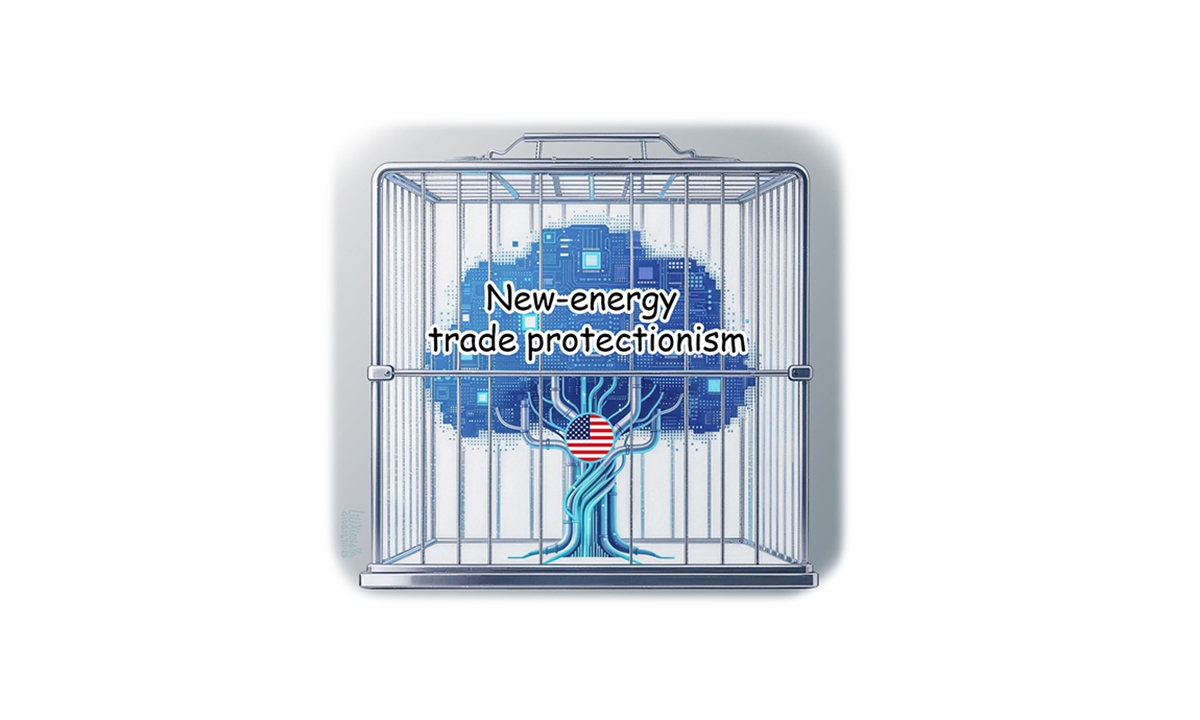
Illustration: Liu Xiangya/GT
Recent media reports have questioned whether a natural gas plant built to power an Amazon data center project in Texas could become the largest climate polluter in the US. The controversy, whatever the eventual outcome, offers a reality check for America's artificial intelligence (AI) drive.
It exposes a growing contradiction: The US is racing to expand its AI capabilities, yet its protectionist trade policies are making it harder and more costly to access some of the clean-energy technologies needed to sustain that expansion. This raises a broader question: Can an energy-intensive AI race afford the costs of renewable energy protectionism?
The US is entering a new era of rising electricity demand. Data centers, the backbone of the AI economy, are emerging as one of the fastest-growing sources of power consumption. Much of that demand is still being met by fossil fuels: The International Energy Agency reports that natural gas supplies more than 40 percent of the electricity used by data centers in the US, making it their largest source of power.
So, it's not surprising that the expansion of data centers has raised concerns over their environmental impact and the pressure they could place on local power systems and electricity bills. A Gallup survey conducted in March found that seven in 10 Americans opposed the construction of AI data centers in their local area, including 48 percent who strongly opposed such projects.
The findings point to a broader challenge for the US: The race to develop AI is increasingly becoming a race to meet growing energy needs. Addressing this challenge will require more than advances in computing technology; it will also depend on an energy system capable of delivering large amounts of reliable, affordable and cleaner power. That, in turn, will require faster development and broader deployment of clean-energy technologies, from solar power to energy storage.
Yet in the clean-energy sector, the US has increasingly relied on protectionist trade measures that limit access to cost-competitive products from global markets. The country has placed greater emphasis on expanding domestic manufacturing capacity, but rebuilding entire clean-energy supply chains at home is a costly and time-consuming process. Even if expanded domestic production is achieved, it is likely to come at a higher cost, making the deployment of renewable technologies more expensive and potentially slower.
The solar industry offers a clear illustration of this policy direction. The US has continued to expand trade barriers in the sector. Reuters reported that the US government announced on Thursday a series of price floors and a 15 percent tariff on products made from polysilicon, a raw material used in solar panels.
The challenge lies in the limited scale of the US polysilicon industry. Reuters reported that the country has two polysilicon factories. Against this backdrop, relying on domestic polysilicon production while restricting access to imports runs counter to the goal of expanding solar power in the US. The country risks creating barriers that ultimately constrain its own access to the global supply chains needed for growth.
The pressing issue for the US is the speed at which new power demand is emerging. The expansion of data centers is creating electricity needs that cannot wait for domestic clean-energy capacity to develop gradually. Global supply chains can provide the scale and speed required in the near term. By narrowing access to these sources, the US risks turning clean-energy policy into a drag on the infrastructure needed for its AI race.
The US has placed AI high on its economic and technological agenda. The outcome of this race will matter greatly, as financial markets are also watching whether America can turn its AI efforts into commercial success.
This leaves the US with a difficult choice: Can it afford the cost of clean-energy protectionism while racing to build AI infrastructure? The answer may be no. Trade barriers that limit access to competitive renewable technologies could ultimately become a constraint on the AI expansion that Washington is seeking to accelerate.
The author is a reporter with the Global Times. [email protected]
。 American entertainment giant Warner Bros, the distributor of the film adaptation of the Harry Potter saga, has slammed a death threat recently made online against JK Rowling, author of the books series.,Earlier, when Rowling voiced her concerns on Twitter about the health of Salman Rushdie, who was stabbed in New York last week, a Meer Asif Aziz simply tweeted to her: “Don’t worry you are next.”,Aziz identified himself on the social media platform as a “student, social activist, political activist and research activist” from Pakistan, and has previously voiced his support for Iran’s supreme leader Ayatollah Ali Khamenei.,In response, Warner Bros. Discovery said in a statement that they strongly condemn the threats made against Rowling, and that they “stand with her and all the authors, storytellers and creators who bravely express their creativity and opinions.”,“WBD believes in freedom of expression, peaceful discourse and supporting those who offer their views in the public arena,” the company said, as quoted by The Hollywood Reporter. “Our thoughts are with Sir Salman Rushdie and his family following the senseless act of violence in New York. The company strongly condemns any form of threat, violence or intimidation when opinions, beliefs and thoughts might differ.”,Receiving death threats is unfortunately not exactly uncommon for Rowling, who has previously alleged that she was getting so many threats she could “paper the house with them.”,The said barrage of threats, which has already prompted a police investigation into the matter, ensued after the author criticized an article that used the term "people who menstruate" instead of "women," something that earned Rowling the enmity of quite a few trans activists.。
Current article:http://6o4zj5.minpinpengcemiuanjiuxuan.pics/list_mi6n4xw/ayk36z2.html
Published on:00:47:38
